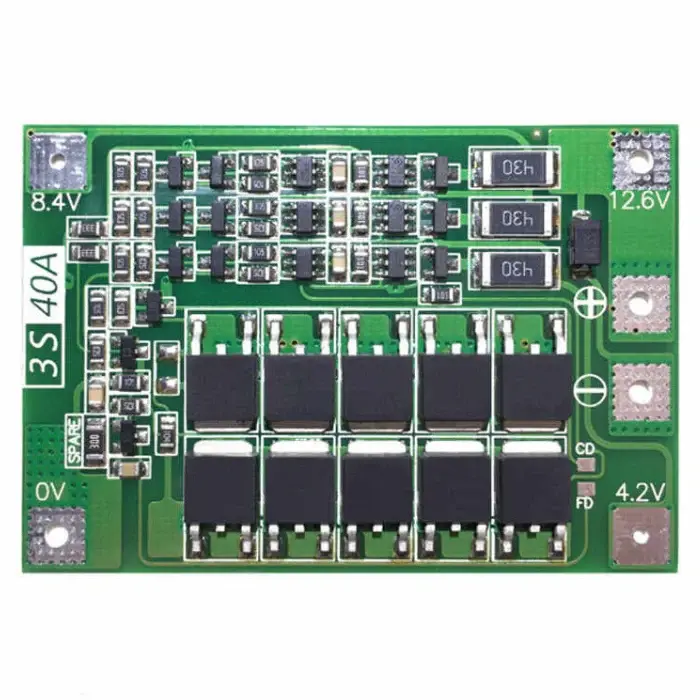
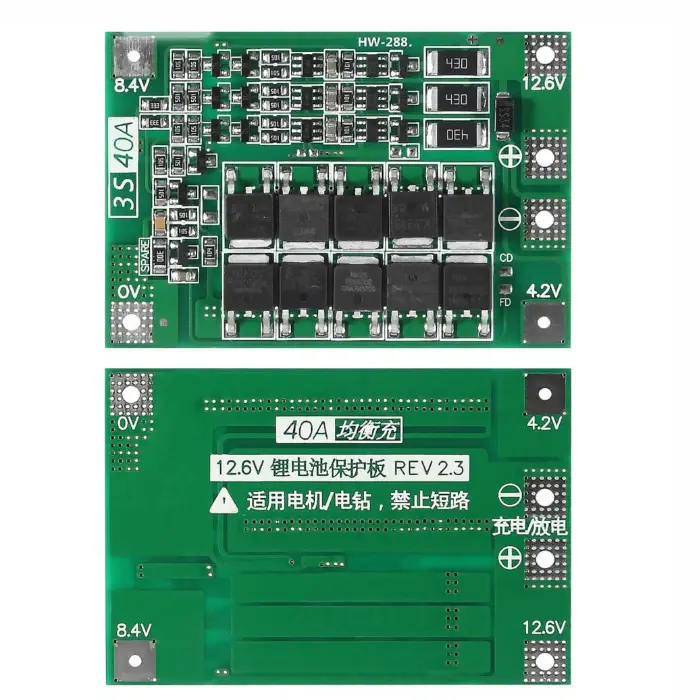
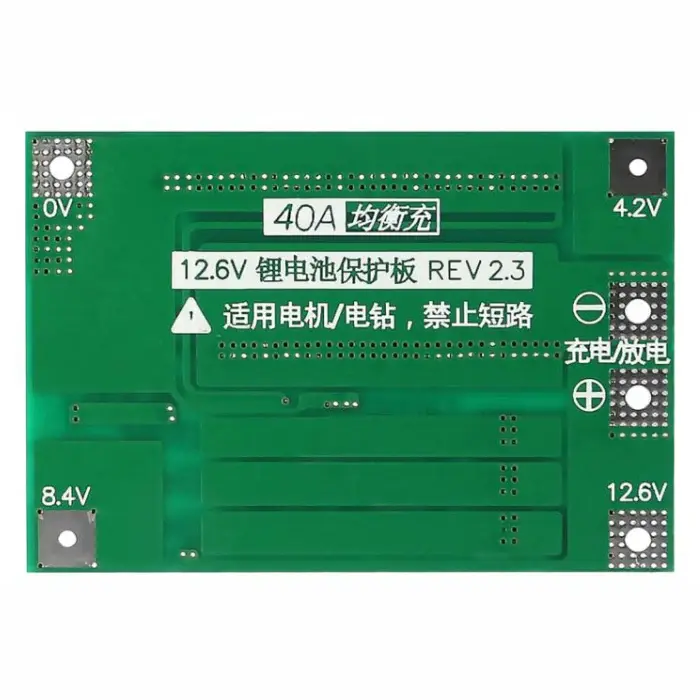
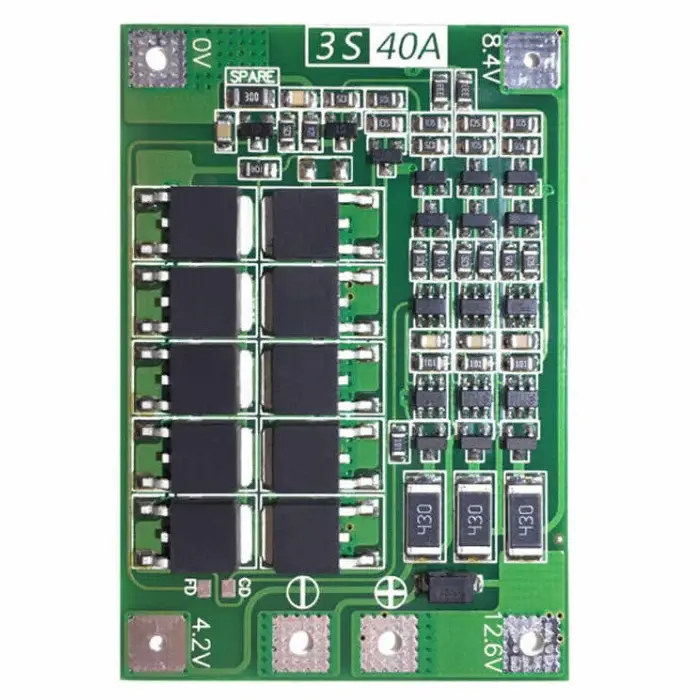
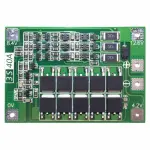
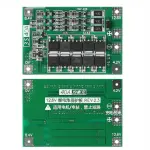
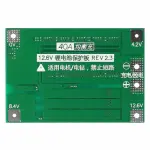
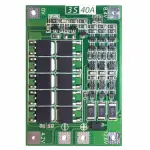
3S 40A Lithium Battery Protection Board with Balance Function (11.1V–12.6V)
The 3S 40A Lithium Battery Protection Board is designed to provide reliable protection and balancing for 3-cell lithium battery packs. Suitable for applications such as electric drills, agricultural sprayers, LED lighting systems, and low-power inverters, the board features an automatic recovery function and high-performance MOSFETs for stable operation.
The board supports a continuous discharge current of up to 40A and includes a balancing current of 100mA to ensure uniform charging and discharging across battery cells. It is compatible with 3.6V and 3.7V lithium batteries, including 18650, 26650, and lithium polymer cells.
With a charging voltage range of 16.8V–18.1V and a maximum continuous charging current of 20A, this protection board is ideal for battery-powered devices requiring dependable performance. Its compact dimensions (46 × 60 × 3.4 mm) allow easy integration into battery packs and space-constrained applications.
Key Features
- 3S lithium battery protection board for 11.1V–12.6V battery packs
- Integrated cell balancing function (100mA balancing current)
- Automatic recovery after protection events
- Supports 3.6V and 3.7V lithium cells, including 18650, 26650, and Li-Po batteries
- Maximum continuous discharge current: 40A
- Maximum continuous charging current: 20A
- Built-in low-resistance MOSFETs for efficient power handling
- Suitable for electric drills, sprayers, LED lighting systems, and low-power inverters
- Compact and lightweight design for easy installation
Specifications
- Battery Configuration: 3S (3 Cells in Series)
- Nominal Voltage: 11.1V
- Fully Charged Voltage: 12.6V
- Charging Voltage Range: 16.8V–18.1V
- Continuous Discharge Current: 40A
- Continuous Charge Current: 20A
- Balancing Current: 100mA
- Dimensions: 46 × 60 × 3.4 mm
Important Notes
For electric drill applications, use high-discharge lithium batteries:
- Three 15C–20C batteries, or
- Six 10C–15C batteries.
Standard 18650 cells may not provide sufficient startup current.
- Follow the wiring sequence carefully:
- 0V → 4.2V → 8.4V → 12.6V → 16.8V
- Incorrect wiring may damage the protection board.
- Avoid short-circuiting the battery terminals.
- When using brushed DC motors, connect a non-polar capacitor (10µF–100µF, voltage rating above 25V) across the motor terminals to suppress reverse voltage spikes and protect the MOSFETs.
- For battery packs connected in series, ensure all cell groups have the same voltage before use. If voltage levels differ, charge each cell group individually. Cells that discharge significantly faster than others may be defective and should be replaced.