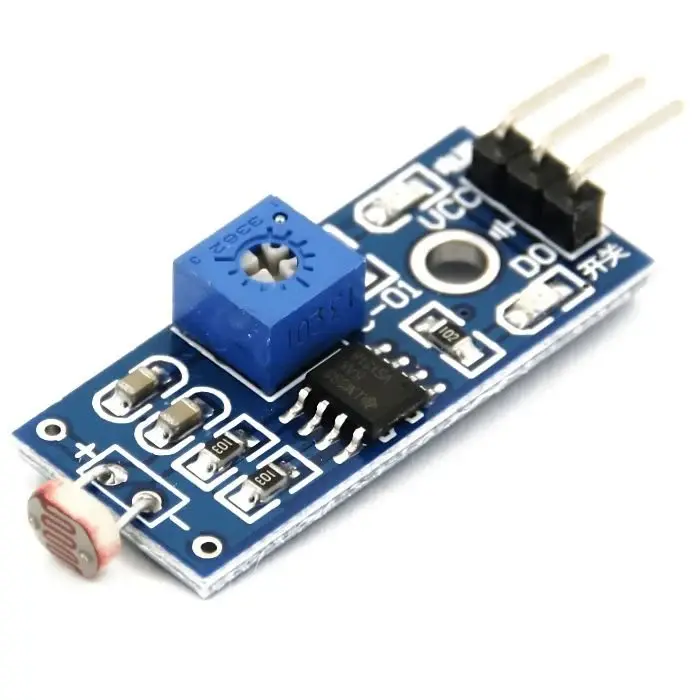
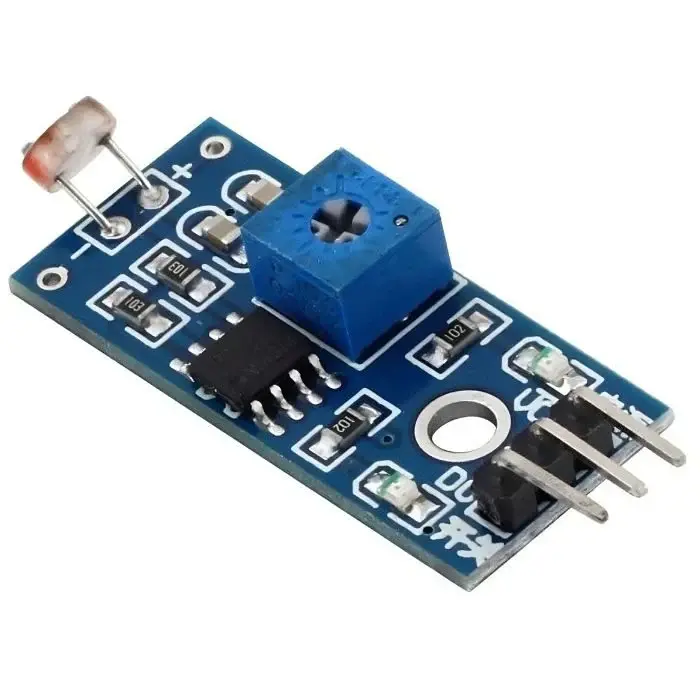
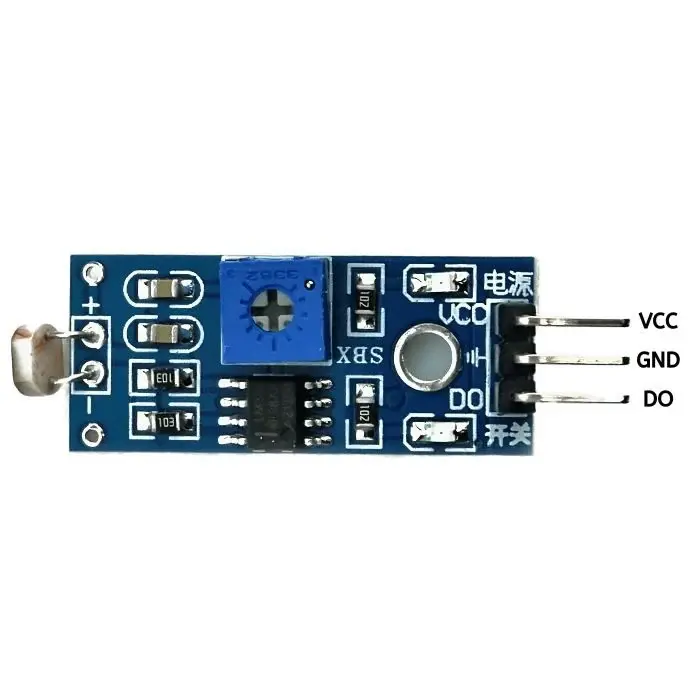
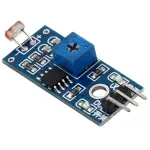
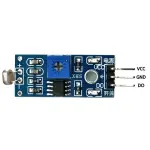
The LDR sensor module is used to detect light intensity and measure how bright the surroundings are. When light is present, the module outputs a high signal, and in low or no light conditions, the output goes low. Its sensitivity can be easily adjusted using an onboard potentiometer.
This module includes an M3 mounting hole for convenient installation and comes equipped with an LDR for precise light sensing. It also features a power LED and a status LED to indicate its operation, making it a reliable choice for monitoring ambient light levels.
Features:
- Adjustable sensitivity via blue digital potentiometer adjustment
- Digital output range: 0V to 5V
- Adjustable trigger level from preset
- LEDs indicating output and power (Power indicator in red and digital switch output indicator in green)
- Uses LM393 comparator chip for stability
- Easy to install with an M3 mounting hole for attachment
- Suitable for detecting ambient brightness and light intensity
- Digital output for easy integration with microcontrollers
- Comes with a power LED and status LED as indicators
Applications:
- Control lights with LDR sensors.
- Adjust streetlights for energy savings.
- Trigger alarms in security.
- Monitor sunlight for plants.
- Optimize camera settings.
How to Use:
- A photosensitive resistor module most sensitive to environmental light intensity is generally used to detect the ambient brightness and light intensity.
- Module light conditions or light intensity reach the set threshold, DO port output is high when the external ambient light intensity exceeds a set threshold, the module D0 output is low;
- Digital output D0 is directly connected to the MCU, and detects high or low TTL, thereby detecting ambient light intensity changes;
- Digital output module DO can directly drive the relay module, which can be composed of a photoelectric switch;